
Gokbilge EngineeringGOKBILGE

Completed project · 2016-2017

Suduragi-Ayranci high-speed railway section, part of the Karaman-Ulukisla line

Construction of 23 route-km of double-track high-speed railway (approximately 46 track-km, design speed >250 km/h) on the Suduragi-Ayranci section, including 1.2 km of NATM tunnel, three viaducts and bridges, four underpasses and five overpasses.

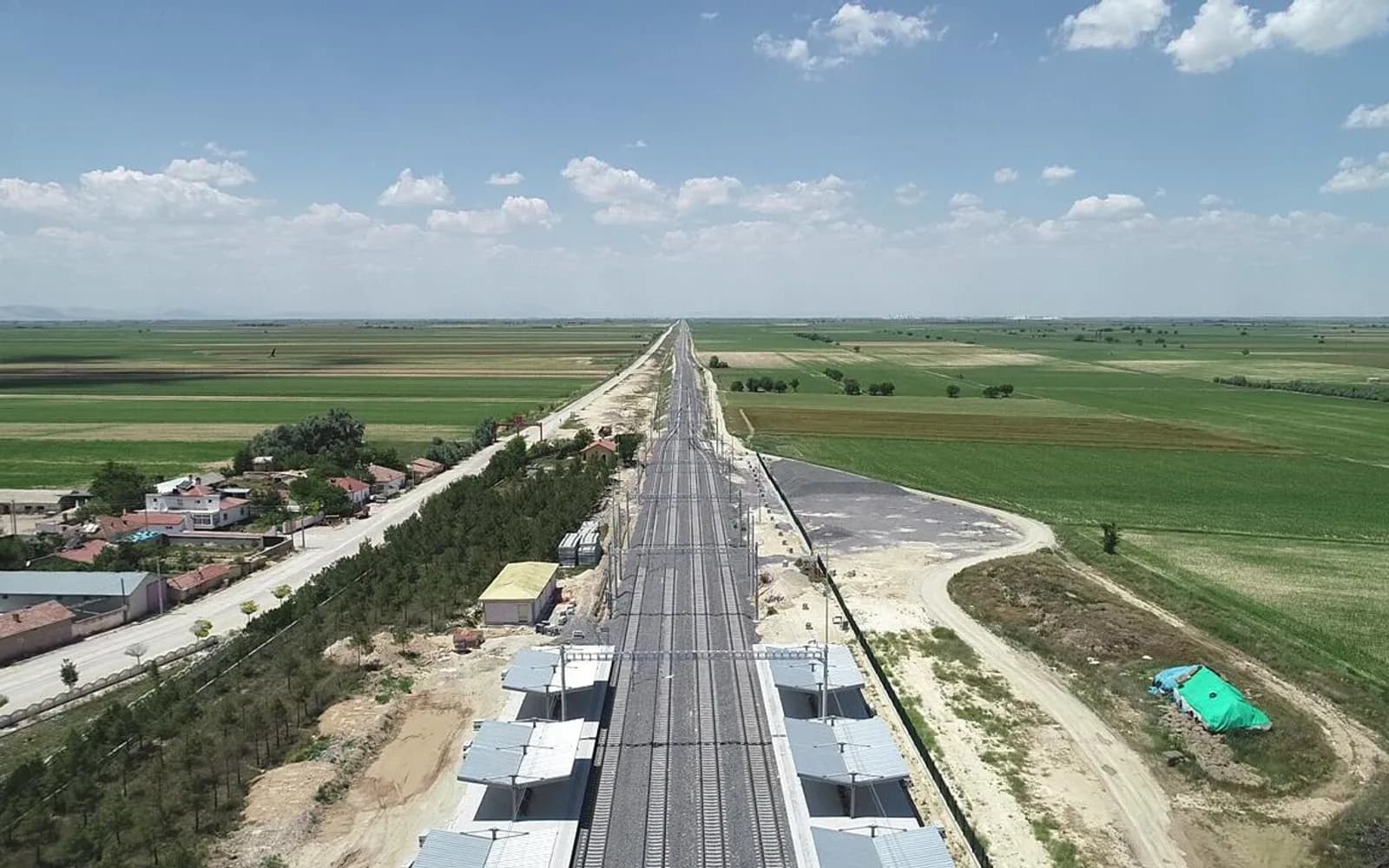
Aerial view of the completed Suduragi-Ayranci high-speed railway line with overhead catenary running through farmland.
Period
2016-2017
Gokbilge role
Railway construction contractor

Key quantities

Route length
23 route-km
Track length
approx. 46 track-km
NATM tunnel
1.2 km
Viaducts
3

Gokbilge's contracted scope was completed in 2017. The subsequent overall status of the wider project has not been independently verified.

The Karaman-Ulukisla line is part of a wider approximately 135 km double-track high-speed rail corridor designed for speeds above 250 km/h. Gokbilge's scope on the Suduragi-Ayranci section covered 23 route-km of double-track railway infrastructure and superstructure (approximately 46 track-km), including 1.2 km of tunnel works executed using the New Austrian Tunnelling Method (NATM).

Status reported at the end of Gokbilge's contracted scope (2017): the first line was finished and awaiting test clearance before traffic could be diverted from the existing line, after which disassembly and excavation would begin on the second line. A geological fault fracture encountered during later tunnel segments had delayed the phase 2 works. Status beyond 2017 has not been independently verified for this page.

  • 23 route-km of double-track railway (approximately 46 track-km); first line completed
  • 1.2 km NATM tunnel, three viaducts, nine grade-separated crossings
  • Track testing coordination ahead of traffic diversion to the new line

Project experience

Delivery context and execution approach

The sections below add technical context to the published project facts without introducing undisclosed commercial or customer claims.

01

Execution context and engineering challenge

The Suduragi-Ayranci assignment formed part of the wider Karaman-Ulukisla high-speed rail corridor and combined linear earthworks, railway infrastructure and superstructure with major structures along a 23 route-km section. The scope included approximately 46 track-km of double-track railway, a 1.2 km NATM tunnel, viaducts, bridges and grade-separated crossings, creating a programme in which geotechnical, structural and railway interfaces had to advance in a controlled sequence.

Tunnel progress and geological conditions directly affected downstream construction planning. A geological fault fracture encountered during later tunnel segments delayed phase-two works, illustrating the need to connect field geology, excavation sequence, structural response and overall programme decisions rather than treating tunnel production as an isolated work package.

02

Completion control and railway readiness

At the end of Gokbilge's contracted scope in 2017, the first line had been completed and was awaiting test clearance before traffic could be diverted from the existing line. That transition required physical completion, track readiness and testing to be aligned before the next construction sequence could proceed.

The project demonstrates Gokbilge's experience in managing infrastructure where civil completion and operational readiness are interdependent. Progress must be evaluated against usable railway sections, verified structures and defined traffic-transfer conditions rather than construction quantity alone.

03

Work-front logic across tunnel, structures and railway formation

A 23 route-km railway section containing tunnel, viaduct, bridge and formation works cannot be managed as one undifferentiated construction front. Each structure has its own prerequisites, access needs, production rates and downstream dependencies, while the railway programme ultimately requires these separate fronts to converge into a continuous usable alignment.

The practical control point is readiness by location: excavation, support, drainage, structural completion, formation and track-related activities must become available in a sequence that protects the overall corridor programme. This is particularly important where geotechnical events affect one work front but the wider project still needs progress to continue elsewhere.

04

What this reference demonstrates

This project is a strong reference for Gokbilge's contracting capability because it combines measurable civil quantities with technically different work fronts and an operational transition condition. The published facts show direct involvement in railway infrastructure and superstructure rather than a purely advisory assignment.

For future transport and infrastructure clients, the relevance is the ability to coordinate civil production, structures, technical interfaces and completion criteria under one delivery view. The lesson is transferable to other linear infrastructure where progress depends on many geographically separated work fronts reaching readiness in the correct sequence.